A Conversation with Jordan James | Hydrographic Party Chief
NEW YORK STATE
Finding Your Way to Hydrography
Q: Jordan, hydrographic surveying is a unique field that combines technology, navigation, and fieldwork on the water. How did you get started in hydrography, and what drew you to this type of work?
A: While pursuing my bachelor’s degree in geology at the College of Charleston, I took a course about processing hydrographic data and really enjoyed the experience. My professor mentioned Prudent was hiring hydrographic survey technicians, so I decided to apply. As a survey technician, I am able to work outside, travel around NY, and learn a lot of useful skills. Everyday is different, which makes it interesting and fun.
A Day on the Water
Q: For those who may not be familiar with hydrographic surveying, what does a typical day in the field look like for you? What kind of equipment and technology are you using to collect data?
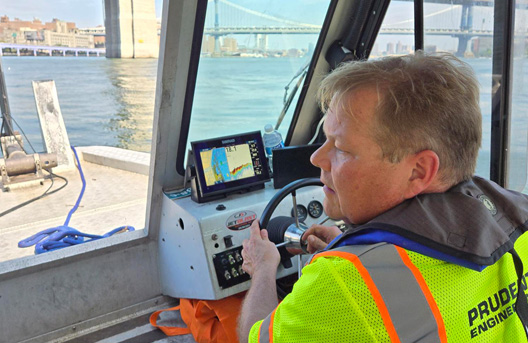
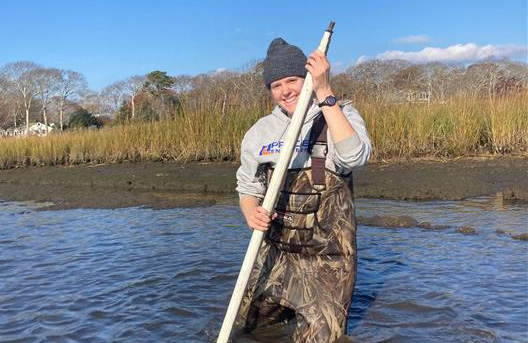
A: My day really depends on the type of project we’re working on that week. We could be surveying a small bridge over a creek in the Adirondacks, mapping Chautauqua Lake in Jamestown, or locating a pipeline in New York City. For a lot of projects, we’re on a survey vessel and using a multibeam sonar to collect data, but we also have a remote-controlled Z-boat that has a sonar as well. For our smaller projects, we might be in an inflatable raft or waders and using a GPS and Total Station to complete our survey.
The Details Beneath the Surface
Q: Hydrographic work often reveals what can’t be seen from above the water. What are some of the most interesting or challenging things you’ve encountered while mapping underwater features?
A: Honestly, most of the challenges in my job are a result of adverse field conditions or troubleshooting malfunctioning equipment. However, I have seen a half-submerged car in the Bronx River, and I saw a whale while transiting from Long Island to New York City.
Perspective in the Field
Q: Hydrographic surveying teams are made up of people from many different backgrounds and experiences. From your perspective, what has your experience been like working in this field, and what encouragement would you offer to other women considering a career in hydrography?
A: My experience in the field of hydrography has been positive thus far. I’ve been lucky enough to work with a great team of people, including a female boat captain, that bring a variety of knowledge and experience to the department. I’ve learned a lot of skills, such as integrating and operating new types of equipment, as well as trailering a boat. My advice to other women considering hydrography would be to have confidence in yourself and your abilities but to also ask questions. It’s a collaborative field, and there are lots of female hydrographers here to offer support.
The Value of Hydrographic Data
Q: The data your team collects plays an important role in engineering, infrastructure planning, and environmental understanding. From your perspective in the field, why is accurate hydrographic data so important?
A: The data we collect in the field provides insight into conditions that are not easily seen by the human eye. It’s important that, as the people providing that insight, we ensure our data is accurate, especially because it affects infrastructure and environmental projects. There are a myriad of factors that affect data quality and accuracy, such as site conditions and equipment malfunctions. It is imperative that, as a field technician, that information is recorded and relayed to the drafter so that the client receives an accurate product.